
Application Security (AppSec) is the practice of protecting software applications from threats and vulnerabilities throughout their lifecycle. It ensures the confidentiality, integrity, and availability of data within applications. Common types include authentication and authorization controls, encryption, input validation, secure coding practices, and application of firewalls. These measures help prevent attacks like SQL injection, cross-site scripting, and unauthorized access, making applications resilient against cyber threats.
This guide explains what application security means, why it matters, common application security examples, essential tools, and best practices to keep your systems safe.
Why is Application Security Important?
1. Applications store and process sensitive data like financial details and personal identifiers. Strong security measures prevent unauthorized access and misuse.
2. Attackers exploit application vulnerabilities to infiltrate systems and steal information. Securing applications reduces the attack surface and strengthens defenses.
3. A breach can disrupt functionality and halt operations. Robust application security ensures reliability and minimizes downtime.
4. Secure applications build trust and protect brand reputation by demonstrating a commitment to user data protection.
5. Industries such as healthcare and finance require compliance with strict data privacy regulations. Application security helps meet these standards and avoid penalties.
6. Fixing vulnerabilities early in development is far cheaper than addressing breaches later. Proactive security saves time and money.
Cyber Security Training ProgramsJoin our online course to learn and build career in Cyber Security.Cybersecurity Online Courses

Common Risks to an Application
1. Broken Access Controls: Access control ensures users can only access what they’re authorized to. When these restrictions fail, users with limited privileges may access sensitive data. This is now the top OWASP risk, with 94% of tested apps showing some form of broken access control.
2. Cryptographic Failures: Formerly called “Sensitive Data Exposure,” this risk involves weak or flawed encryption, leaving sensitive data like credit card details and session tokens exposed. Proper encryption and secure logic are essential to prevent unauthorized access and identity theft.
3. Injection Flaws: Injection attacks (SQL, NoSQL, OS, LDAP) occur when untrusted data is sent as part of a command or query, tricking the system into executing unintended actions. Cross-Site Scripting (XSS) also falls here, enabling attackers to hijack sessions or redirect users to malicious sites.
4. Insecure Design: Added in 2021, this category highlights flaws in system architecture and missing security controls. It emphasizes the need for threat modeling, secure design principles, and reference architectures to prevent vulnerabilities at the design stage.
5. Security Misconfiguration: Common in highly configurable systems, this includes insecure defaults, incomplete setups, and exposed cloud storage. Even minor misconfigurations, like verbose error messages, can lead to breaches. XML External Entity (XXE) vulnerabilities are now part of this category.
6. Vulnerable and Outdated Components: Applications using outdated libraries or components with known vulnerabilities create easy entry points for attackers. Regular updates of operating systems, frameworks, and third-party libraries are critical to maintaining security.
Core Practices Application Security
Application security includes several key techniques such as authentication, authorization, encryption, logging, and testing. These methods work together to protect applications from unauthorized access, data breaches, and compliance risks.
1. Authentication
Authentication is the process of verifying a user’s identity before granting access to an application. Common methods include passwords, biometric scans, and multi-factor authentication (MFA), which adds extra layers of security. Strong authentication prevents identity-based attacks such as credential theft and ensures only legitimate users can access sensitive data.
2. Authorization
Authorization defines what an authenticated user can do within an application. It enforces role-based access control (RBAC) or policy-based permissions, ensuring users only access the resources they are entitled to. Proper authorization reduces risks like privilege escalation and data breaches, complementing authentication for a complete security model.
3. Encryption
Encryption safeguards sensitive data by converting it into unreadable code using cryptographic algorithms. This ensures confidentiality during storage (data at rest) and transmission (data in transit). Implementing strong encryption standards like AES or TLS prevents data exposure in case of interception or breaches, making it essential for compliance and trust.
4. Logging and Monitoring
Logging records user activities and system events, creating an audit trail for monitoring, incident response, and regulatory compliance. Effective logging captures authentication attempts, data access, and configuration changes. Combined with real-time monitoring, it enables proactive threat detection and rapid response to security incidents.
5. Application Security Testing
Application security testing validates security controls throughout the software development lifecycle (SDLC). Techniques like SAST (Static Analysis), DAST (Dynamic Analysis), IAST (Interactive Analysis), and penetration testing identify vulnerabilities in code and running applications. Regular testing ensures applications remain secure before deployment and during runtime.
Read our article about the CIA Triad
Key Stages of Application Security Implementation
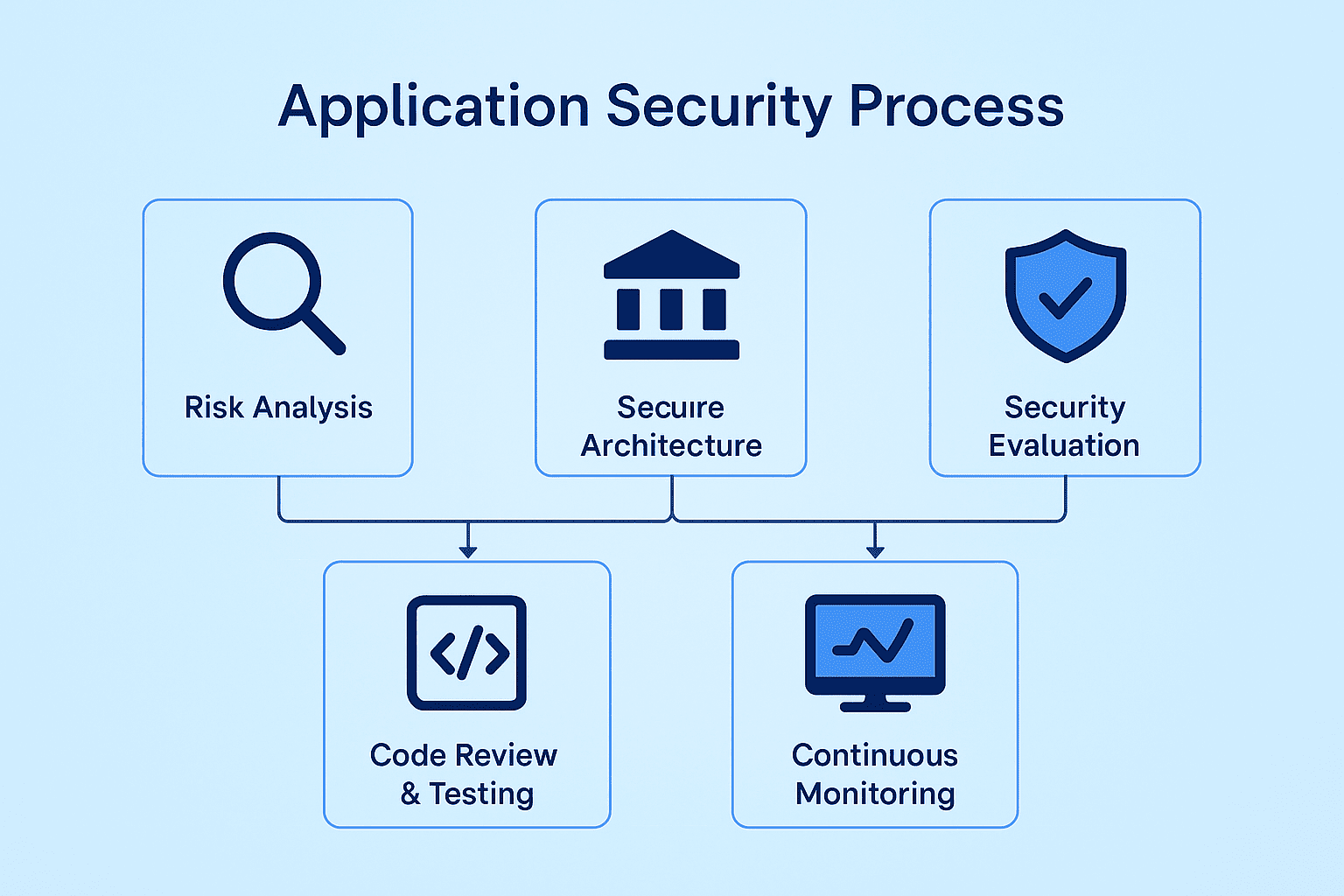
The application security process follows a structured approach that begins with identifying risks and continues through secure development, testing, and ongoing monitoring to ensure applications remain resilient against evolving threats.
1. Risk Analysis and Strategic Planning
The first step involves conducting a detailed risk assessment to uncover potential threats specific to the application. This includes threat modeling, evaluating data flows, and identifying attack vectors. Based on these insights, a comprehensive security strategy is developed, outlining preventive measures and controls to address identified risks effectively.
2. Secure Architecture and Development
Security must be integrated into the design and development stages. Teams adopt secure coding practices and follow industry best practices to minimize vulnerabilities. Key measures include input validation, robust authentication, proper error handling, and secure deployment pipelines. This proactive approach ensures security is built into the application from the ground up.
3. Code Review and Vulnerability Testing
Thorough code reviews and testing help detect and remediate security flaws early. Static analysis examines source code for weaknesses, while dynamic testing simulates real-world attacks on a running application. These combined efforts strengthen the application’s resilience against exploitation and ensure adherence to security guidelines.
4. Comprehensive Security Evaluation
Advanced security testing validates the effectiveness of implemented controls. Techniques such as penetration testing, vulnerability scanning, and risk assessments identify remaining weaknesses. This phase ensures the application meets compliance requirements and is prepared to withstand sophisticated attack scenarios.
5. Deployment and Continuous Monitoring
After deployment, security doesn’t stop. Continuous monitoring and maintenance are essential to detect anomalies and respond to incidents promptly. Logging, real-time alerts, and regular patching help address emerging threats and maintain application integrity over time.
Application Security Tools
| Category | Purpose | Tool Examples |
|---|---|---|
| SAST (Static Application Security Testing) | Analyzes source code or binaries for vulnerabilities before deployment. Detects issues like buffer overflows and insecure coding practices. | SonarQube, Checkmarx, Veracode |
| DAST (Dynamic Application Security Testing) | Tests running applications externally (black-box) to find runtime vulnerabilities such as XSS or SQL injection. | Burp Suite, OWASP ZAP |
| IAST (Interactive Application Security Testing) | Combines SAST and DAST by monitoring code execution during runtime for accurate vulnerability detection. | Contrast Security, Synopsys Seeker |
| SCA (Software Composition Analysis) | Identifies known vulnerabilities in open-source libraries and third-party dependencies. | Black Duck, Sonatype Nexus, Snyk |
| RASP (Runtime Application Self-Protection) | Embedded in the application to detect and block attacks in real-time, e.g., SQL injection. | Imperva RASP, Contrast Protect |
| WAF (Web Application Firewall) | Filters and blocks malicious HTTP traffic to protect web apps from common attacks. | Imperva WAF, AWS WAF, Cloudflare |
| API Security Tools | Secures APIs against threats like injection, broken authentication, and unauthorized access. | Salt Security, 42Crunch |
| Cloud-Native Security (CNAPP) | Protects cloud-native environments, containers, and Kubernetes workloads. | Microsoft Defender for Cloud, Prisma Cloud |
Application Security Best Practices
1. Shift Security Left in the SDLC
Integrate security early in the software development lifecycle (SDLC). Use DevSecOps principles to embed security checks during coding, build, and deployment stages. This reduces vulnerabilities before production.
2. Implement Strong Authentication and Authorization
Adopt multi-factor authentication (MFA) and role-based access control (RBAC) to ensure only authorized users access sensitive resources. Avoid hardcoded credentials and enforce least privilege policies.
3. Use Secure Coding Standards
Follow industry guidelines like OWASP Top 10 to prevent common vulnerabilities such as SQL injection, XSS, and insecure deserialization. Validate all inputs, sanitize outputs, and handle errors securely.
4. Encrypt Data Everywhere
Apply strong encryption algorithms (e.g., AES-256, TLS 1.3) for data at rest and in transit. Use secure key management practices and avoid outdated protocols like SSL.
5. Regular Vulnerability Scanning and Penetration Testing
Perform SAST, DAST, IAST, and penetration tests regularly to identify and fix weaknesses. Automate scans in CI/CD pipelines for continuous security assurance.
6. Secure APIs and Third-Party Integrations
APIs are a major attack surface. Use API gateways, enforce authentication, and validate all requests. Monitor third-party libraries for vulnerabilities using tools like SCA (Software Composition Analysis).
7. Continuous Monitoring and Logging
Implement real-time monitoring with SIEM tools and maintain detailed logs for authentication attempts, data access, and configuration changes. Use anomaly detection powered by AI/ML for proactive threat response.
8. Patch Management and Updates
Keep applications, frameworks, and dependencies updated. Automate patching where possible to reduce exposure to known vulnerabilities.
9. Secure Cloud Deployments
For cloud-hosted apps, follow CSP security guidelines, enable encryption, and configure IAM roles properly. Use container security tools for Kubernetes and Docker environments.
10. Train Developers and Teams
Human error is a major risk. Conduct regular security training for developers and operations teams to ensure awareness of emerging threats and secure coding practices.
Application Security Jobs and Salary
Application security professionals are in high demand globally. In India, an Application Security Engineer earns an average of ₹10–₹17 lakh annually, while in the U.S., the same role commands between $96,000 and $140,000 per year, with top-tier positions exceeding $200,000.
Beyond engineers, the application security domain offers multiple career paths. Here’s a look at popular roles and their average salaries in India:
1. Application Security Analyst: ₹12–₹17 LPA
2. Senior Application Security Analyst: ₹18–₹22 LPA
3. Application Security Engineer: ₹10–₹17 LPA
4. Application Security Architect: ₹25–₹35 LPA
5. DevSecOps Engineer: ₹15–₹20 LPA
Conclusion
Application Security is no longer optional it is a critical component of modern software development. With applications serving as the backbone of digital transformation, securing them against evolving threats ensures data integrity, user trust, and business continuity.
By implementing robust security practices, leveraging advanced tools, and integrating security early in the SDLC, organizations can significantly reduce risks. For professionals, AppSec offers a rewarding, future-proof career with diverse opportunities and continuous growth.

Gautam Kumar
Linkedin Profile: https://www.linkedin.com/in/gautam-sharma-068336173/ Gautam Kumar is a senior network engineer having more than 7 years of experience in different companies in India. His work experience in network support and operation and maintaining of any network makes him one of the most valuable IT professional in industry. He has ...
More... | Author`s Bog | Book a MeetingRelated Articles
#Explore latest news and articles
 24 Dec 2025
List of Top Cyber Security Certifications in 2026
This article provides the list of top cyber security certification for highest salaries. We have covered the best cyber security certifications for beginner and ...
 6 Jan 2026
What is a Hacker and How many types of Hackers are There?
Discover the 18 different types of hackers, their unique skills, motivations, and the impact they have on cybersecurity.
 13 Nov 2025
Top 10 Pentesting Tools for Ethical Hackers and Cybersecurity Pros
Discover the top 10 pentesting tools that every ethical hacker and security professional should know. From automated scanners to powerful manual tools,
FAQ
What is the difference between application security and network security?
Application security focuses on protecting software applications from vulnerabilities and attacks, while network security safeguards data and resources across networks. Both are essential for cybersecurity, but application security deals with code-level threats, whereas network security addresses unauthorized access and data interception.
Why is application security important for cloud-based applications?
Cloud applications face unique risks like misconfigured storage, insecure APIs, and shared infrastructure vulnerabilities. Application security ensures encryption, secure coding, and compliance, reducing exposure to breaches and data leaks in cloud environments. It’s critical for SaaS, PaaS, and multi-cloud deployments.
What are common application security vulnerabilities?
Typical vulnerabilities include SQL injection, cross-site scripting (XSS), insecure authentication, broken access control, and exposed APIs. These flaws allow attackers to steal data or compromise systems. Following OWASP Top 10 guidelines helps developers prevent these issues during application development.
What certifications help in building a career in application security?
Certifications like Certified Ethical Hacker (CEH), CISSP, and Certified Application Security Engineer (CASE) enhance credibility. Specialized credentials in secure coding and cloud security also boost job prospects. These certifications validate skills in vulnerability assessment, secure development, and compliance.
Comments (0)


Popular posts


What are the Different Types of Network ...
29 Jul 2026
What is the Syllabus for CCNA ...
17 Jul 2026
Transmission Media and Its Types in ...
6 Jun 2026
CCNA Exam Fees and Expenses Breakdown
25 Aug 2025Recent posts

18 Types of Cyber Crime: definition, ...
7 Aug 2026
What are the Different Types of Network ...
29 Jul 2026
Understanding Cisco Firepower - A Secure ...
23 Jul 2026
Understanding VLAN Trunking Protocol ...
23 Jul 2026
Benefits and Drawbacks of Virtualization ...
17 Jul 2026Upcoming batches






Contact learning advisor